One-Sided Limits (AP Exam Favorite)
Calculus I
Here's where the AP exam gets clever. It doesn't just test the regular limit — it tests whether the function approaches the same value from the LEFT and from the RIGHT
Notes & explanation
Builds directly on the limit notation from the previous video by adding the small and superscripts.
Reading the notation
- The minus means approaching from the left — from values less than .
- The plus means approaching from the right — from values greater than .
The video notes both phrasings mean the same thing; pick whichever you find easier to remember and stick with it.
When does the limit exist?
("iff" is just mathematician shorthand for if and only if.) So you must check both sides before you can claim the two-sided limit exists.
Worked example
Two graphs are read off the board, and , each asking for the limit as .
For : approaching from the left, the -values close in on ; approaching from the right, they also close in on . The one-sided limits agree, so
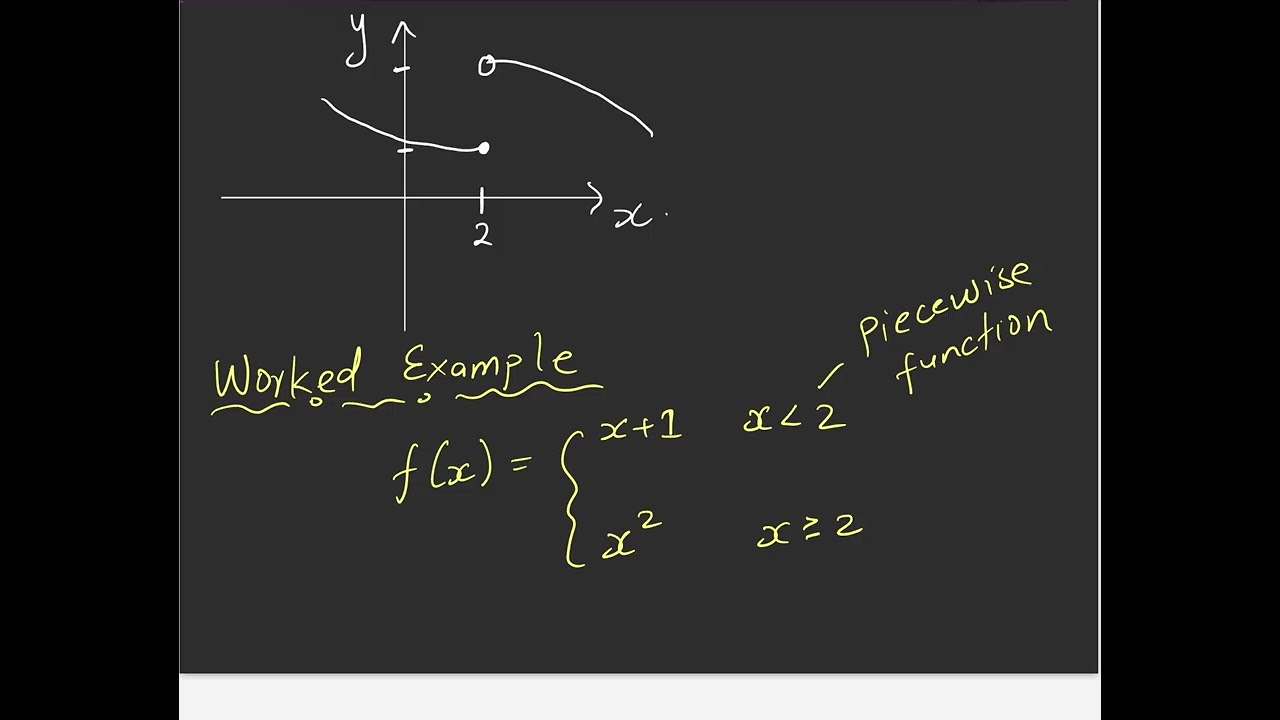
For : approaching from the left, the -values climb towards (the graph shows an open circle there — is not defined at that point, but the limit only cares about the journey). Approaching from the right, the graph jumps to a visibly higher branch and the -values head towards a different, larger value. Since
the two-sided limit does not exist, written DNE on the board.