Jump Discontinuities (When the Limit Does Not Exist)
Calculus I
A jump discontinuity occurs when the function approaches two different values from the left and right side of a point. Picture a staircase instead of a ramp, a ramp is smooth and continuous, but a staircase has a sudden vertical jump at each step. That jump is exactly what this discontinuity looks like on a graph
Notes & explanation
What a jump discontinuity is
A jump discontinuity occurs when the function approaches two different values from the left and from the right of a point.
Formal notation
The video sketches this: a curve coming in towards from the left and settling at one height, and a separate branch leaving from the right at a different height — a visible gap between the two.
Worked example
This is a piecewise function, so each side uses a different rule.
The method used throughout: always try direct substitution first — if the piece is a polynomial or otherwise continuous, you get a real number and can stop there.
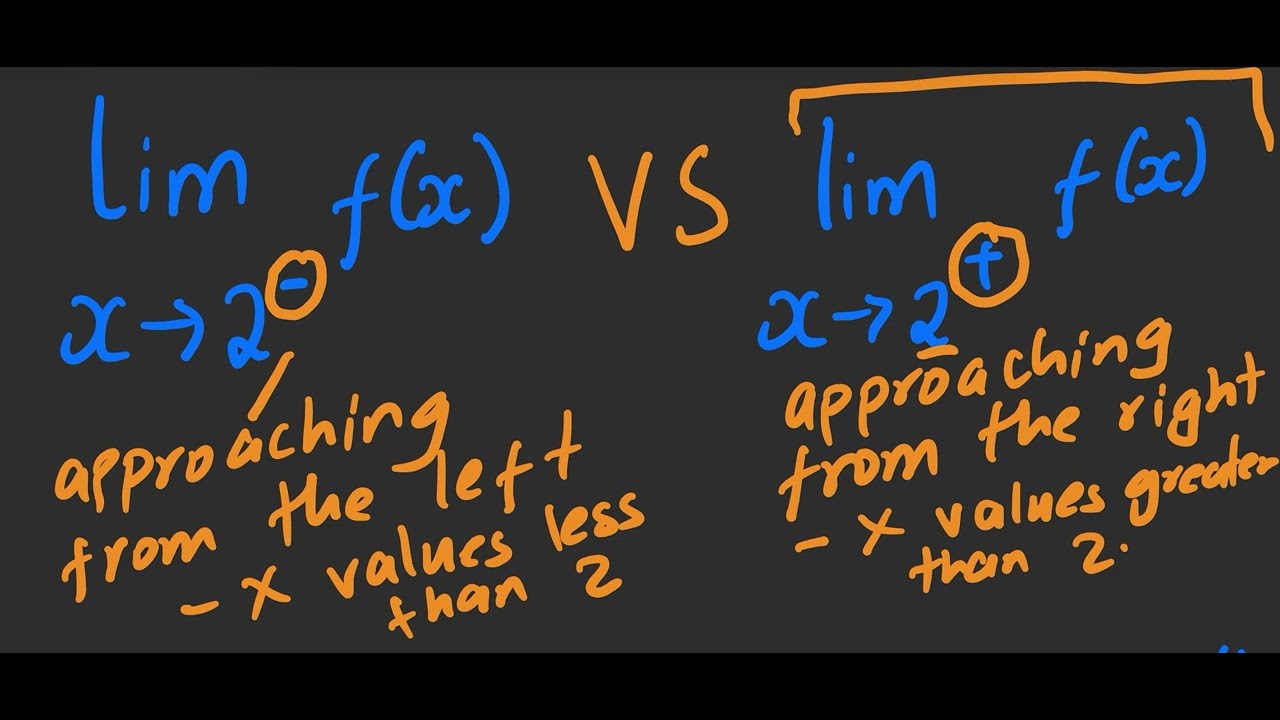
Left-hand limit. Approaching from values less than , the function is :
Right-hand limit. Approaching from values greater than , the function is :
Conclusion. The one-sided limits disagree:
and because they disagree by a finite gap, this is a jump discontinuity.